Learn Spanish with Netflix: Best Shows by Level
Spanish shows on Netflix from beginner to advanced, how to set up dual subtitles, the accents you'll hear, everyday phrases, and a realistic progress timeline.
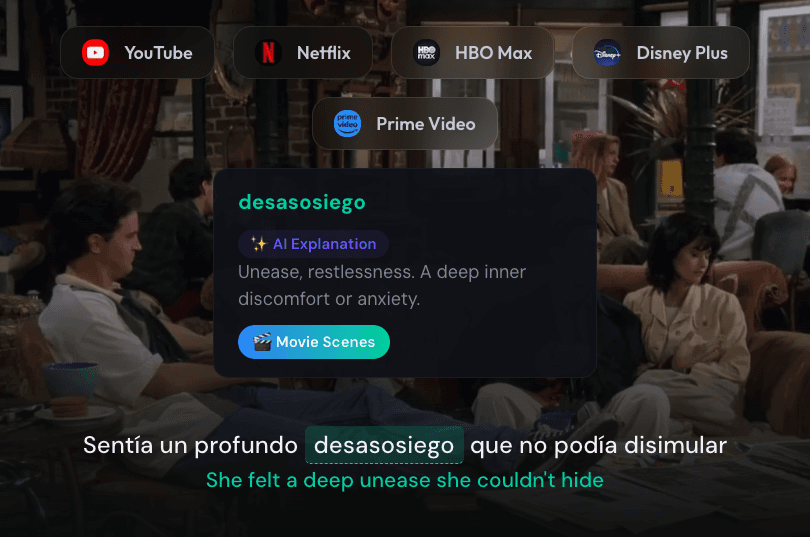
To learn Spanish with Netflix, pick a show that matches your level, watch it with Spanish subtitles and a translation line underneath, and save the words you look up so you can review them later. Below you'll find Spanish shows and films on Netflix from beginner to advanced, how to set up dual subtitles, the accents you'll hear, phrases worth noticing, and a realistic idea of how fast you'll progress.
Netflix's catalog varies by country, so search for each title in yours.
Why Watching Works
It's easy to assume that watching TV is too passive to count as studying. Linguist Stephen Krashen argued the opposite: we acquire a language by understanding messages in it, which he called comprehensible input. Researchers still debate how far input alone can take you, but the key word is comprehensible.
Native-speed Spanish with no subtitles is too hard for most learners. Spanish-only subtitles work for intermediate learners. Dual subtitles, with Spanish on top and your own language underneath, make the same scene followable at almost any level.
Lingosive makes those subtitles interactive. Hover over a word for a quick translation, or click it and the AI explains what it means in that sentence. Save it, and it syncs to your phone for spaced-repetition review.
Setting Up Dual Subtitles for Spanish
- Install Lingosive from the download page. It works in Chrome, Edge, Brave, and other Chromium browsers.
- Choose your own language, set Spanish as the language you're learning, and sign in.
- Open a show on Netflix and turn on Spanish subtitles in Netflix's own subtitle menu. Lingosive replaces them with clickable subtitles.
- Click the double subtitle button next to the subtitles, or press N, to add a translation line in your language.
Lingosive builds its subtitles from the track you pick, so the show needs Spanish subtitles in your region. For a step-by-step walkthrough, see our Netflix dual subtitles page.
Away from your laptop, the Lingosive app has a library of 400,000+ YouTube videos and podcasts with dual subtitles, Spanish included, that you can use without any streaming subscription.
The Best Spanish Shows on Netflix by Level
The best show for you has dialogue you mostly understand, with enough new vocabulary to stretch you. Here's the whole list at a glance:
| Level | Title | Type | Spanish you'll hear |
|---|---|---|---|
| Beginner | Pocoyo (Spanish audio) | Kids' series | Simple narration |
| Beginner | A show you already know, dubbed | Any | Varies |
| Lower intermediate | Club de Cuervos | Series | Mexico |
| Lower intermediate | La Casa de Papel (Money Heist) | Series | Spain |
| Lower intermediate | ¿Quién mató a Sara? (Who Killed Sara?) | Series | Mexico |
| Lower intermediate | Nowhere | Film | Spain |
| Upper intermediate | Élite | Series | Spain |
| Upper intermediate | Narcos | Series | Colombian setting, mixed accents, plus English |
| Upper intermediate | Berlín | Series | Spain |
| Advanced | Las Chicas del Cable (Cable Girls) | Series | Spain, 1920s |
| Advanced | Cien años de soledad (One Hundred Years of Solitude) | Series | Colombia |
| Advanced | El hoyo (The Platform) | Film | Spain |
Beginner
Start with content where the language is slow and simple, or where you already know the story.
- Pocoyo (Spanish audio): a preschool cartoon with short episodes, simple narration, and plenty of repetition. Your Netflix may offer it with Spanish audio but no Spanish subtitles; if so, treat it as listening practice.
- A show you've already seen, switched to Spanish audio: many Netflix titles have a Spanish dub, and knowing the plot frees your attention for the language. Spanish subtitles on a dubbed show often don't match the audio word for word, because dubs and subtitles are translated separately.
Lower Intermediate
You know the basics. Now you need volume: lots of Spanish you can follow at natural speed.
- Club de Cuervos: a Mexican comedy about siblings fighting over the family's soccer club, with clear, everyday Mexican Spanish.
- La Casa de Papel (Money Heist): a heist thriller from Spain, gripping enough that you'll actually finish it.
- ¿Quién mató a Sara? (Who Killed Sara?): a Mexican mystery thriller with standard Mexican Spanish and cliffhangers that keep you watching.
- Nowhere: a Spanish survival film whose heroine spends most of the story alone at sea, so there's less dialogue to keep up with than in a busy series.
Upper Intermediate
You're ready for faster speech, slang, and more than one accent.
- Élite: a teen drama set at an elite private school, with fast, modern Spanish and plenty of slang.
- Narcos: the story of Colombia's drug cartels, starting with Pablo Escobar, and the agents chasing them, in a mix of Spanish and English with many Colombian characters.
- Berlín: the Money Heist prequel spin-off, full of quick, witty dialogue.
Advanced
You're chasing nuance now: literary language, older speech, and dense ideas.
- Las Chicas del Cable (Cable Girls): a period drama set at a telephone company in 1920s Madrid, with more formal speech from another era.
- Cien años de soledad (One Hundred Years of Solitude): the adaptation of Gabriel García Márquez's novel, with a Colombian cast and literary narration.
- El hoyo (The Platform): a dystopian Spanish thriller whose dialogue is dense with ideas about power and society.
Is Money Heist Good for Learning Spanish?
Yes, Money Heist (La Casa de Papel) is good for learning Spanish once you can follow everyday conversation with Spanish subtitles, as long as you watch it in the original Spanish. It's a Spanish series, filmed in Spanish and set in Madrid; the Italian song you hear, "Bella ciao," is an old partisan anthem the gang adopts as its own.
The Spanish is Spain's, at full speed: vosotros and the th sound described in the accents section below, everyday words like vale ("OK") and tío ("man"), and plenty of slang and swearing. Arguments and standoffs are fast, with characters talking over each other, while the Professor's step-by-step explanations of the plan are calmer and easier to follow. Tokyo narrates the story in voice-over, and Palermo, an Argentine character who joins in Part 3, brings an Argentine accent.
If you're watching Money Heist to learn Spanish, play it on netflix.com in a Chromium browser on your computer. Netflix may start it in the English dub, so open Audio & Subtitles, choose Spanish (usually labeled [Original]), and turn on Spanish subtitles. Lingosive turns them into clickable words and adds a machine translation in your language underneath (press N).
Hover over a word for a quick translation, or click it to open the word card, with other meanings, pronunciation, and up to five lines from the same episode where the word comes up. When slang doesn't add up, Lingosive AI explains what the word means in that line, and S replays a line that went by too fast.
Netflix's catalog and subtitle languages vary by country, so Money Heist may not be on your Netflix; if it is, check that its details list Spanish under both Audio and Subtitles.
The Spanish Accents You'll Hear
One of Netflix's underrated advantages for Spanish learners is accent variety. Hearing several accents early builds comprehension that holds up when you meet real people.
Spain. In most of Spain, c before e or i and the letter z are pronounced like the th in think (linguists call this distinción), and people say vosotros for "you all." Best shows: La Casa de Papel, Élite, Las Chicas del Cable.
Mexico. Mexico has more Spanish speakers than any other country, which makes Mexican Spanish a practical choice if you're aiming for Latin America. Best shows: Club de Cuervos, ¿Quién mató a Sara?
Colombia. Colombian Spanish varies a lot from region to region. Best shows: Narcos, Cien años de soledad.
Argentina. In Buenos Aires Spanish, ll and y sound like the English sh (or the s in measure), and people say vos instead of tú. Best shows: El Marginal, Apache: La vida de Carlos Tevez. It's worth hearing once you have intermediate foundations.
How to Study, Not Just Watch
Watching with subtitles isn't the same as studying. To get real results from your Netflix time, you need a system.
Save words as you watch. When you click a word and read the explanation, save it. You don't need dozens: ten useful words per episode, reviewed regularly, adds up to more than 3,000 words a year at an episode a day.
Hear each word in other scenes. After a session, search the words you saved in Word in Film and watch real movie and TV scenes where other speakers use them. To explore, our list of common Spanish words ranks them by how often they come up in movies, series, and videos, and every word opens real scenes. Hearing a word from different people in different situations helps move it from "I recognize that" to "I know that."
Shadow the dialogue. Pause after phrases you want to be able to say, and repeat them out loud. Match the speaker's rhythm and intonation, not just the words. This builds the muscle memory that separates people who understand Spanish from people who can speak it.
Wean yourself off the translation. Start with both subtitle lines visible. Once you notice you're reading the Spanish before checking the translation, hide the translation line for stretches (press N), or turn on Blur mode (press B) so subtitles stay blurred until you hover over them. The occasional confusion is where growth happens.
Review on your phone. The words you save are waiting in the Lingosive app. Ten minutes of review on your commute reinforces what you watched the night before, and the app's own library means you can keep listening to Spanish when you're nowhere near Netflix. For more on choosing an extension and studying with Netflix in other languages, read our guide to language learning with Netflix.
Phrases Worth Paying Attention To
Spanish is full of expressions that don't translate literally. Pay attention when these come up; native speakers use them constantly.
- No pasa nada: "it's fine" or "don't worry," used to brush something off or reassure someone.
- Venga (Spain): okay, come on, let's go, or bye, depending on context.
- Sale (Mexico): a very common "okay" or "deal," used to agree to plans.
- A ver: "let's see," but also a filler, a pause, or a way to change the subject.
- Tío / Tía (Spain): literally "uncle" or "aunt," used like "man" or "dude."
- ¡Qué fuerte! (Spain): "wow" or "that's crazy."
You won't find most of these in a textbook, but you'll hear them in almost every episode.
Realistic Progress Timelines
Spanish is one of the more accessible languages for English speakers, but fluency still takes time. If you start at a lower-intermediate level and watch 30–60 minutes a day with regular vocabulary review, a rough timeline looks like this:
| Timeframe | What changes |
|---|---|
| 4 weeks | Common phrases start to feel automatic, and you catch them without reading |
| 3 months | You follow most plots with Spanish subtitles and check the translation less often |
| 6 months | Natural-speed Spanish is mostly understandable; you look up new words, not sentence structure |
| 12 months | Strong listening across several accents; your remaining gaps are mostly vocabulary |
These are rough expectations for consistent learners, not guarantees. Speaking practice speeds things up, and watching without reviewing slows them down.
Frequently Asked Questions
Is Élite a good show to learn Spanish?
Yes, once Money Heist feels comfortable. Élite follows students at an exclusive private school in Spain, so the Spanish is fast, young, and full of current slang; keep the translation line on at first and click the slang you don't know. Like Money Heist, it may start in the English dub, so check that the audio is Spanish.
Is Narcos good to learn Spanish?
Partly. Narcos switches between Spanish and English: the American DEA agents speak English, and so does the narration. Its Spanish comes from a cast of many nationalities, including Brazilian actor Wagner Moura, who learned Spanish to play Pablo Escobar, so you hear Colombian voices mixed with many other accents.
Should I watch with Spanish audio or Spanish subtitles on English content?
Spanish audio on content you already know is a valid starting point, especially for beginners, because knowing the story frees you up to focus on the language. But original Spanish-language shows are better as soon as you can follow them, because the acting, the pacing, and the vocabulary are written to sound natural in Spanish rather than translated into it.
Is it better to watch shows I enjoy or shows that are "educational"?
Shows you enjoy. Boredom is the enemy of language acquisition. If you're invested in the story, you'll keep watching, and volume matters more than almost any other factor.
What if I don't understand anything at first?
Turn on both subtitle lines, don't pause constantly, and let the story carry you. Understanding comes gradually as words and patterns repeat across episodes, and the first episode of any show is always the hardest.
Can I become conversational just from Netflix?
You'll develop strong comprehension and a wide vocabulary. Conversational fluency also requires practice producing Spanish: speaking, writing, and responding in real time. Netflix gives you the foundation; conversations put it to use.
Start practicing today!
Get started for free
The extension works in Chrome, Edge and Brave on a computer.
All download optionsKeep reading
- Learn French with Netflix: Best Shows by LevelHow to learn French with Netflix: the best shows for your level, French and English subtitles at onc…
- Learn German with Netflix: Best Shows by LevelHow to learn German with Netflix: the best German shows for your level, how to avoid English dubs, m…
- Learn Italian with Netflix: Best Shows by LevelHow to learn Italian with Netflix: the best shows for your level, Italian and English subtitles at o…